What PM2.5 Actually Is
The particle behind every wildfire-smoke number, explained from scratch — how small it is, where it comes from, and why its size drives both lung and heart risk.
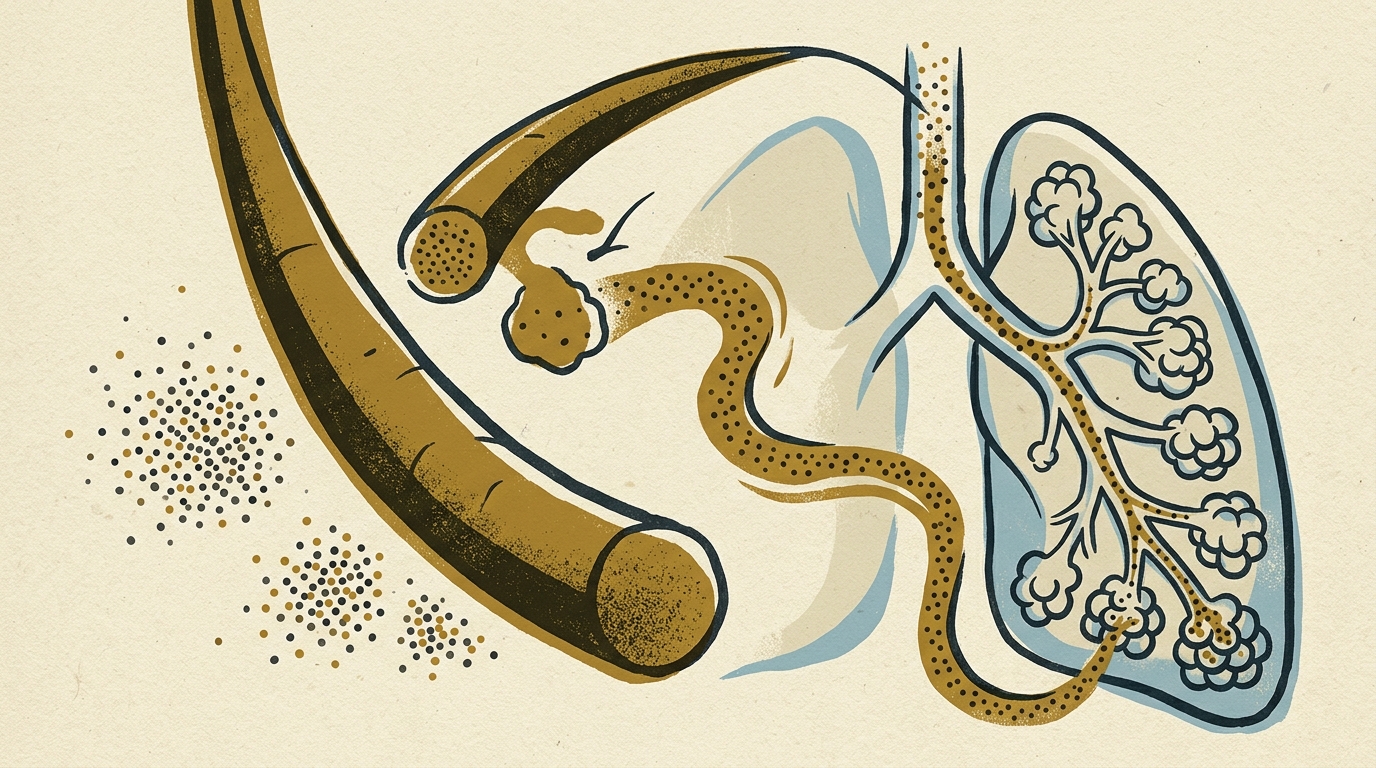
PM2.5 is airborne particulate matter 2.5 microns or smaller — roughly 30 times thinner than a human hair, and small enough to slip past the nose and throat that filter out everything bigger. In wildfire smoke it's mostly soot, tar, and ash thrown off by vegetation that didn't fully burn, and its size, not its chemistry, is why health agencies treat it as the most dangerous thing in the plume.
The short version
- PM2.5 means particles 2.5 microns or smaller — small enough to bypass the nose and throat and reach the deepest part of the lungs.
- Wildfire PM2.5 forms from incomplete combustion: vegetation burning without enough oxygen leaves behind soot, tar, and ash instead of burning clean.
- Some of it crosses from the lungs into the bloodstream, which is why smoke exposure raises heart attack and stroke risk, not just coughing and asthma flares.
- PM10, ozone, and "smoke smell" (VOCs) are separate hazards with separate sources — none of them stand in for a PM2.5 reading.
- PM2.5 is the pollutant AQI, air-quality rankings, and evacuation advice are actually built around during a smoke event.
What exactly is PM2.5?
"PM2.5" is shorthand for particulate matter with a diameter of 2.5 micrometers or less — about 30 times thinner than the average human hair, which runs roughly 50–70 microns across. It isn't one substance; it's a size class that catches soot, ash, condensed organic compounds, sulfates, and trace metals — whatever solid or liquid fragments are small enough to stay suspended in air instead of settling out. During a wildfire, nearly all of that mass is combustion byproduct: carbon particles and organic vapor thrown off by burning wood and vegetation.
Where does wildfire PM2.5 actually come from?
Complete combustion turns fuel entirely into carbon dioxide and water vapor — no smoke, no particle. Wildfires rarely burn that cleanly. Flame fronts move through uneven fuel, moisture, and oxygen supply, so a large share of the material burns incompletely: carbon chains break apart before they fully oxidize, then condense back into soot, tar droplets, and ash rather than finishing the reaction. That incomplete-combustion byproduct is the bulk of wildfire PM2.5 — the visible haze in a smoke plume is that particulate hanging in the air, not water vapor or wind-blown dust.
Why does particle size decide the damage?
Your airway is a size filter before it's anything else. Nose hair and the mucus lining of your throat catch particles down to around 10 microns — most dust, pollen, and mold spores never make it past that point. PM2.5 slips straight through. It travels down into the alveoli, the tiny air sacs where your lungs actually exchange oxygen, and the smallest fraction of it crosses the alveolar wall directly into the bloodstream. That's the mechanism behind two different kinds of harm: respiratory (coughing, asthma flares, reduced lung function) from particles that lodge in the airway and lungs, and cardiovascular (raised blood pressure, arrhythmia, elevated heart attack and stroke risk) from particles and the inflammation they trigger reaching the blood directly. Wildfire smoke carries an unusually large share of its mass in this smallest, deepest-reaching size range.
| Particle class | Size | What normally stops it | Where it ends up |
|---|---|---|---|
| PM10 (coarse) | ≤10 microns | Nose hair, throat mucus | Upper airway; some reaches the upper lungs |
| PM2.5 (fine) — wildfire smoke | ≤2.5 microns | Nothing in the upper airway | Deep lung (alveoli); smallest fraction crosses into blood |
| Ultrafine (UFP) | ≤0.1 micron | Nothing | Alveoli, bloodstream, and beyond |
| Human hair, for scale | ~50–70 microns wide | — | — |
How is PM2.5 different from PM10, ozone, and "smoke smell"?
PM10 is the wider size class — up to 10 microns — that includes coarser dust, pollen, and mold spores your nose and throat catch before they reach the lungs; wildfire smoke carries some PM10, but it's overwhelmingly PM2.5 by mass. Ozone isn't a particle at all — it's a gas that forms downwind when sunlight cooks a fire's other emissions in the atmosphere, so ozone problems can peak hours later and miles from the plume itself, typically on hot, sunny afternoons. The smoke smell comes mostly from volatile organic compounds (VOCs) — gaseous chemicals that evaporate off burning wood and can irritate eyes and airways on their own, but disperse on a different timeline than particulate does. Your nose can stop noticing the smell while PM2.5 is still climbing, or catch char from a fire miles away while PM2.5 is barely elevated. None of these three substitute for an actual PM2.5 reading.
A week of air at 100 µg/m³ PM2.5 comes out to about 32 cigarettes a week, by Berkeley Earth's PM2.5-to-cigarettes ratio.
Why is PM2.5 the number health advice sorts on?
When agencies calculate the AQI during a wildfire, PM2.5 is almost always the pollutant that sets the score — see how that conversion actually works. That's not an arbitrary choice: PM2.5 has the clearest, most consistently documented link to both respiratory and cardiovascular harm, at concentrations far below where ozone or coarse PM10 become a comparable concern. It's why every ranking, purifier recommendation, and "should I go outside" call on this site is keyed to a live PM2.5 reading rather than a haze or visibility judgment — visibility can mislead in both directions, and PM2.5 doesn't.
Sources & further reading. EPA — Particulate Matter (PM) Basics; EPA — Health and Environmental Effects of Particulate Matter (PM); American Heart Association — Particulate Matter Air Pollution and Cardiovascular Disease (Circulation, 2010); World Health Organization — Ambient Air Quality and Health.
This article is general information, not medical advice. If you or someone in your household has a heart or lung condition, is pregnant, or is having trouble breathing, talk to a doctor about smoke exposure specific to your situation.
Common questions
What size is a PM2.5 particle?
2.5 microns or smaller in diameter — about 30 times thinner than a human hair, small enough to bypass the nose and throat entirely.
Why is PM2.5 worse for your health than PM10?
PM10 (coarse dust, pollen) is mostly caught by your nose and throat. PM2.5 is small enough to reach the deepest part of your lungs, and some of it crosses into your bloodstream — which is why it's linked to heart attack and stroke risk, not just coughing and asthma.
Does wildfire smoke smell mean the PM2.5 level is high?
Not reliably. The smell comes from volatile organic compounds (VOCs), which disperse on a different timeline than PM2.5 particles do — air can smell clear while PM2.5 is still elevated, or smell smoky while PM2.5 is barely up. Check a live PM2.5 or AQI reading instead of your nose.
How many cigarettes is a week of wildfire smoke equal to?
Using Berkeley Earth's ratio of about 22 µg/m³ of PM2.5 per cigarette, a week of air at 100 µg/m³ works out to roughly 32 cigarettes a week — always reported as a weekly figure, never a daily count.