The Same Smoke Doesn't Cost Everyone the Same
Children, older adults, pregnant people, anyone with asthma, COPD, heart disease, or diabetes, and outdoor workers all pay a steeper price for the same AQI reading — here's why, and the exact point each group should act.
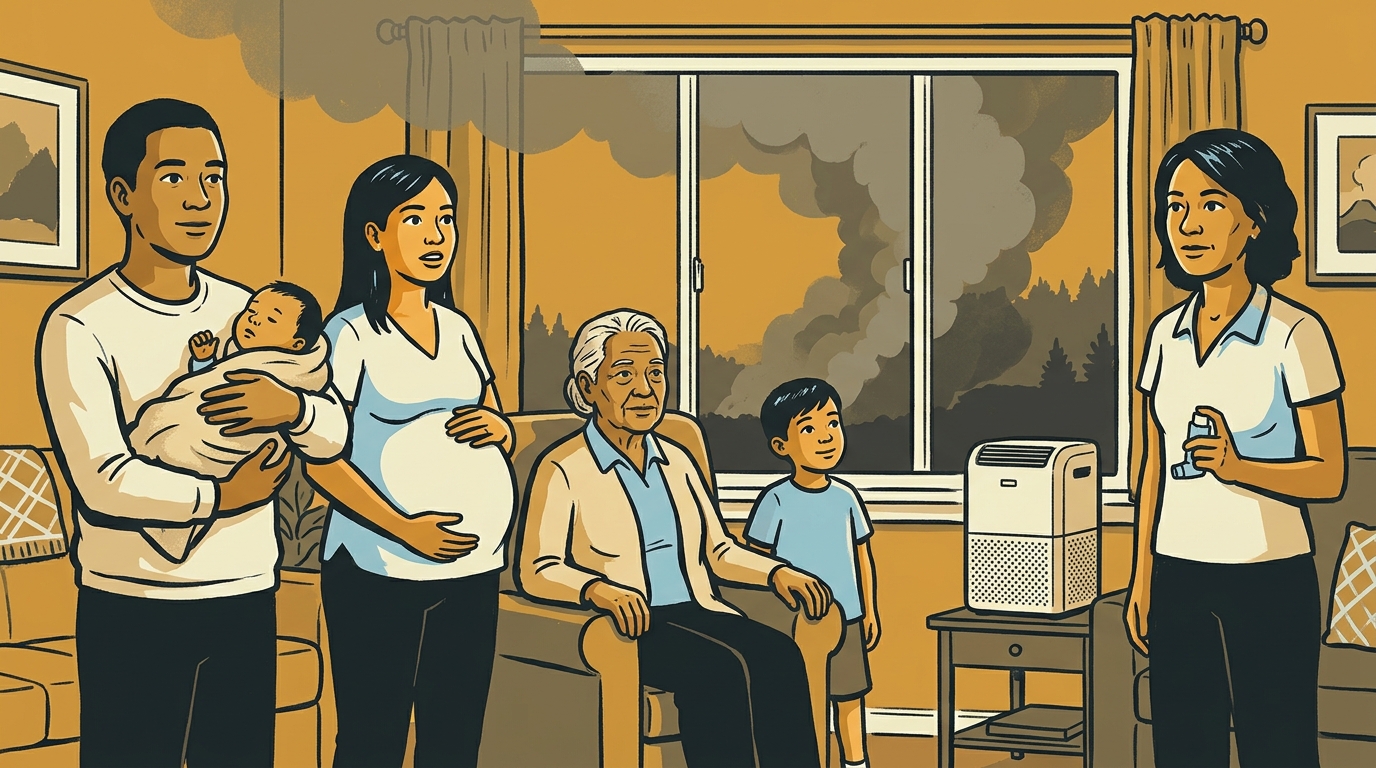
The same smoky air doesn't cost everyone the same. Children absorb a bigger dose per pound, people with heart disease face the highest death toll, and pregnant people, older adults, anyone with asthma, COPD, or diabetes, and outdoor workers all pay a steeper price than the general population — some of them well before the AQI turns red.
The short version
- Sensitive groups should act at AQI 101 — a full 50 points before "Unhealthy" kicks in for everyone else.
- Infants, people in late pregnancy, and anyone with unstable heart or lung disease should act even earlier, in the "Moderate" band (51+).
- Kids breathe faster per pound of body weight than adults, so the same air delivers a bigger dose to lungs that aren't done developing.
- PM2.5 kills more people through the heart than the lungs — it triggers clotting, irregular heartbeat, and heart attacks, not just coughing.
- Outdoor and low-income workers often can't act on any of this — they need protection built into the shift, not just advice to go inside.
Why does smoke hit kids harder than adults?
A child breathes faster than an adult, relative to their size — more breaths per minute, more air moved per pound of body weight. That means more PM2.5 reaching the lungs for the same time spent outside. Their lungs are also still building airways and tissue, a process that doesn't finish until the late teens, so damage from repeated smoke exposure lands on a system still under construction. Kids also tend to be outside longer and more active — recess, practice, playgrounds — which adds exposure time on top of the higher dose rate. Infants have it worse still: newborn lungs and a faster resting breathing rate stack the same problem even higher.
Why are heart disease and older age the biggest share of smoke deaths?
PM2.5 doesn't stay in the lungs — particles small enough cross into the bloodstream, where they trigger inflammation, make blood more prone to clotting, and can destabilize the heart's electrical rhythm. In someone with existing heart disease, that's enough to tip a stable condition into a heart attack, stroke, or dangerous arrhythmia within hours of exposure, not years. Older adults carry more of this risk simply because heart and lung disease become more common with age, and the body has less reserve to absorb the added strain. This is why cardiovascular events, not respiratory ones, account for the largest share of deaths tied to wildfire smoke.
PM2.5's most visible effect is a cough. Its most lethal effect is on the heart.
What does wildfire smoke do during pregnancy?
PM2.5 crossing into the bloodstream doesn't stop at the placenta. Studies link fine-particle exposure during pregnancy to slower fetal growth, lower birth weight, and a higher rate of preterm birth — effects that compound the later in pregnancy the exposure happens. The practical response is the same one that protects a newborn afterward: cut outdoor exertion on smoky days and keep indoor air filtered, especially in the third trimester. What actually helps once the baby arrives covers the filtering setup in more detail.
Why do asthma, COPD, and diabetes make smoke more dangerous?
Asthma and COPD start from airways that are already inflamed or narrowed; smoke's fine particles are a direct irritant on top of that, which is why a flare can start within hours of exposure, not days. Diabetes works differently but lands in the same place — it already damages blood vessels and keeps the body in a low-grade inflammatory state, which compounds PM2.5's effect on clotting and heart rhythm rather than the airways. That's why diabetes sits on the same "sensitive group" list as heart disease, even without a lung symptom in sight.
What about people who can't just stay inside?
Outdoor workers — construction, agriculture, delivery, landscaping — don't get to treat a bad AQI reading as a cue to go inside; the job is outside. Low-income households face a version of the same problem indoors: older housing lets more smoke in, and air conditioning or a purifier isn't guaranteed. For both groups, the fix has to travel with them rather than assume a clean room is available: a properly fitted N95 respirator, scheduled breaks in filtered air where the employer provides it, and shifting the heaviest physical work to the cleanest part of the day. Not every mask on shelves actually filters PM2.5 — the fit matters more than the label.
At what AQI should each group act, and how?
| Group | Why the same air hits harder | Act at AQI | What to do |
|---|---|---|---|
| Children | Faster breathing rate per pound; lungs still developing | 101 | Move recess and play indoors; run a purifier in bedrooms. |
| Older adults | Higher rate of existing heart/lung disease; less reserve | 101 | Skip outdoor errands and exercise; treat new chest tightness same-day. |
| Pregnant people | PM2.5 crosses the placenta; linked to preterm birth | 101 (51 in the third trimester) | Cut outdoor exertion; keep one filtered room at home. |
| Asthma / COPD | Airways already inflamed; smoke is a direct trigger | 101 | Keep rescue medication on hand; move activity indoors early. |
| Heart disease | PM2.5 raises clotting and arrhythmia risk within hours | 51–101 if unstable | Avoid outdoor exertion; don't wait out chest pain or palpitations. |
| Diabetes | Existing vascular damage compounds PM2.5's clotting effect | 101 | Treat it like a heart-disease day: reduce exertion, watch for cardiac symptoms. |
| Outdoor / low-income workers | Can't leave the air; full-shift cumulative dose | 101, earlier if possible | Wear a properly fitted N95; take breaks in filtered air. |
These thresholds sit inside the AQI scale's own bands — see the full color-band table and what each one means for the general-population read.
If there's a dog, cat, or bird in the house too, they're breathing the same smoke on the same day — here's what to watch for in pets.
Sources & further reading. EPA — Particulate Matter (PM) Basics; American Heart Association — Particulate Matter Air Pollution and Cardiovascular Disease (Brook et al., Circulation, 2010); Bekkar et al. — Air Pollution and Heat Exposure With Preterm Birth, Low Birth Weight, and Stillbirth (JAMA Network Open, 2020); CDC — Protect Yourself from Wildfire Smoke.
This article is general information, not medical advice. If you're pregnant, caring for an infant, or managing heart disease, lung disease, or diabetes, talk to a doctor about smoke exposure specific to your situation.
Common questions
At what AQI should sensitive groups start limiting outdoor time?
101 — "Unhealthy for Sensitive Groups" is the cue for kids, older adults, pregnant people, and anyone with asthma, COPD, heart disease, or diabetes. Infants, people in late pregnancy, and anyone with unstable heart or lung disease should act even earlier, in the 51+ "Moderate" band.
Why are people with heart disease at the greatest risk from wildfire smoke?
PM2.5 crosses into the bloodstream and triggers inflammation, promotes blood clotting, and can destabilize heart rhythm — enough to cause a heart attack, stroke, or dangerous arrhythmia within hours. Cardiovascular events, not respiratory ones, account for the largest share of deaths tied to wildfire smoke.
Does wildfire smoke affect a developing baby during pregnancy?
Yes. PM2.5 exposure during pregnancy is linked to slower fetal growth, lower birth weight, and a higher rate of preterm birth, with the risk compounding later in pregnancy. Cutting outdoor exertion and filtering indoor air, especially in the third trimester, is the practical response.
Can outdoor workers protect themselves during a wildfire smoke event?
Partially. A properly fitted N95 respirator filters PM2.5 that cloth and surgical masks don't, and shifting the heaviest physical work to the cleanest part of the day and taking breaks in filtered air help — but full protection requires the schedule to change, not just the gear.