Your baby breathes faster than you do
The smoke that makes your eyes sting is doing more to the smallest lungs in the house. Here is what the research says about how much, at what level, and for how long — and the short list of things that genuinely protect an infant indoors.
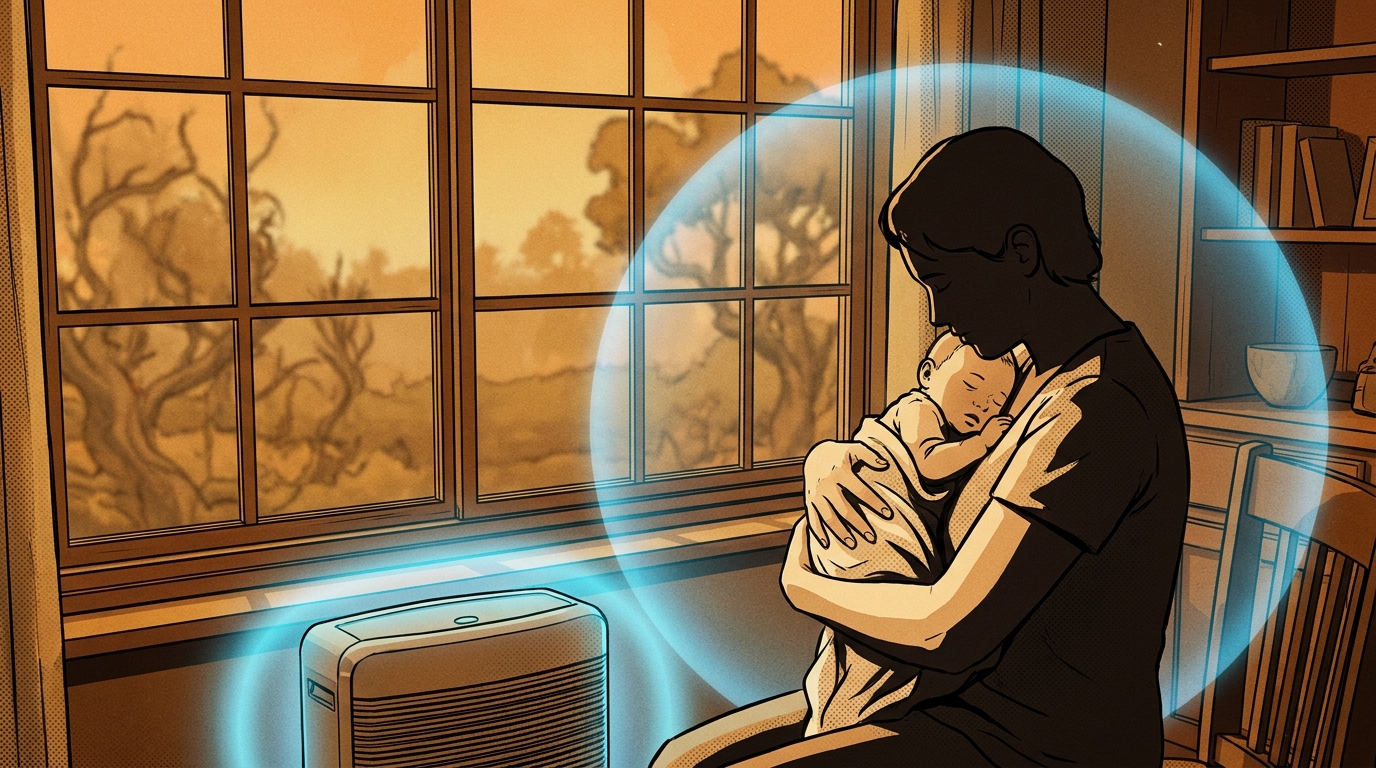
Here's the uncomfortable thing to sit with as a parent on a smoky day: the haze that makes your eyes water and your throat scratchy is landing much harder on the smallest person in the house. Not because babies are fragile in some vague way, but for reasons you can almost picture — and once you can picture them, the right moves get obvious.
Why smoke hits a baby harder than it hits you
Three things stack up against an infant at the same time. They breathe faster — a newborn takes something like twice as many breaths per minute as you do — and relative to their body weight they pull in a lot more air, which means a lot more of whatever is floating in it. Their airways are narrow, and they mostly breathe through the mouth, so they lose some of the nose's built-in filtering. And their lungs and immune systems are still being built; the fine particles in wildfire smoke reach the deep parts of the lung more easily and arrive while the tissue is still developing.
That's the whole reason public-health agencies put infants and young children at the front of the “sensitive groups” line, right next to people with asthma and heart disease. The smoke isn't different for a baby. The lungs are.
At what level should you actually start caring?
Lower than most people assume. The Air Quality Index has a category literally named for your situation:
Once the AQI crosses 101 — “unhealthy for sensitive groups” — your baby is one of the people that category was written for. You don't wait for the scary red and purple numbers. And even in the yellow “moderate” band, if your infant is very young or was born early, it's reasonable to start closing windows and running a filter. The World Health Organization's guideline for fine particles is far stricter than the AQI's green zone suggests: it puts the safe 24-hour average for PM2.5 at around 15 µg/m³, a level a smoke day blows past before breakfast.
A rule of thumb we like: if the app would tell an asthmatic to stay in, it's telling your baby the same thing.
How long does it take to matter?
Two clocks again — the short one and the long one, and honesty about both matters here.
In the moment, a few hours of heavy smoke can leave a baby coughing, wheezy, stuffy, fussy, feeding poorly or sleeping badly. Usually that fades once the air clears. The point of acting fast isn't that one smoky afternoon dooms anyone; it's that you can spare them the dose cheaply, so you should.
Over the long run is where the research gets sobering, and it mostly concerns exposure before birth. Studies tracking wildfire smoke and pregnancy have found that higher PM2.5 exposure is associated with a measurably higher chance of preterm birth — on the order of a few percent of added risk for each step up in smoke exposure — along with links to lower birth weight and to more respiratory infections in the first year of life, with the fetal lung and ear developing through especially sensitive windows in mid-pregnancy. Those particles are small enough to cross from a pregnant person's bloodstream toward the placenta, which is how something you breathe becomes something the baby is exposed to.
Read that the right way. These are population-level risks, not a verdict on your child — plenty of babies breathe a smoky week and are completely fine. But it's exactly why “we'll just tough it out” is the wrong instinct when you're pregnant or holding a newborn, and why a few dollars of air filtering is one of the better trades available to you.
Is indoors completely safe? No — but it can be.
“Just keep the baby inside” is good advice that people badly over-trust. A typical home is not sealed. On a heavy smoke day, indoor PM2.5 quietly drifts up toward whatever it is outside, seeping in around windows, doors and vents — unless you actively do something about it. Worse, you can make your own indoor air dirtier than the smoke without realising: frying dinner, lighting candles or incense, and vacuuming without a HEPA machine all throw fine particles into the exact room you thought was the safe one.
So indoors is your best move — but “inside” and “protected” are not the same thing. Here's the short list that closes that gap.
What actually protects a baby
1. Make one clean room, and seal it
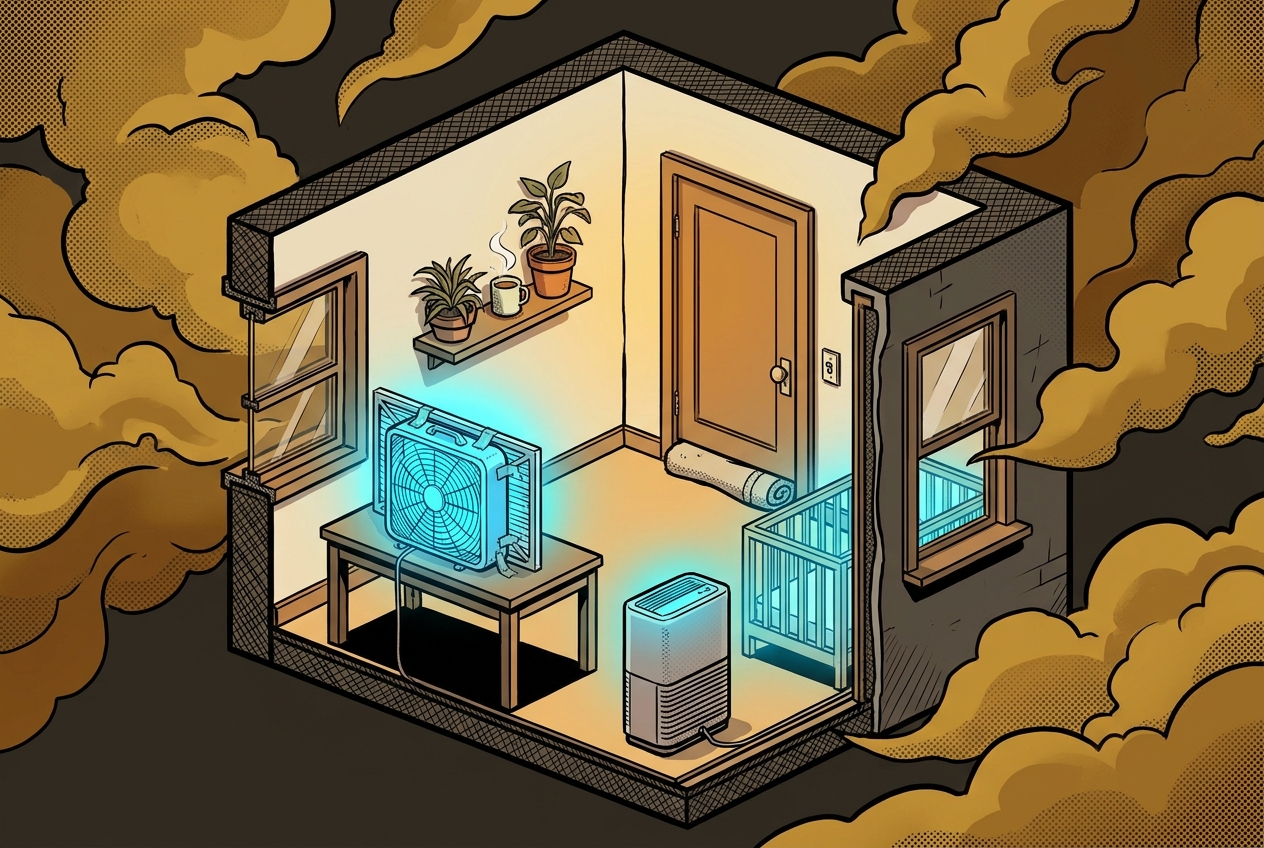
You don't need the whole house clean — you need the room the baby sleeps and feeds in. Close its windows and doors, run the air conditioning on recirculate (not fresh-air intake), and lay a rolled damp towel along any door with a draughty gap. If you have central HVAC, put a MERV-13 filter in it — that's the rating the EPA and the American Academy of Pediatrics both point to for smoke.
2. Filter the air — a real HEPA unit, or the box-fan hack
A portable HEPA air purifier is the single most effective thing most families can add. Size it to the room: you want it rated to cycle the room's air roughly two to three times an hour, so check the room's square footage against the unit's rating rather than eyeballing it. If a purifier isn't in the budget this week, the box fan plus a MERV-13 furnace filter— taped together into a cheap DIY cleaner — genuinely works and is EPA-endorsed for exactly this.
3. Don't add smoke of your own
On a bad-air day, skip the pan-frying and the sheet-pan char, don't light candles or incense, hold off on vacuuming unless the machine has a real HEPA filter, and obviously never smoke or vape near a child, ever, smoke event or not.
4. Do not put a mask on a baby
This one is important and counter-intuitive. N95s and KN95s are not made to fit infants or toddlers — they won't seal on a small face, and a mask on a baby is a suffocation and breathing risk, not protection. There is no baby version that works. The answer for the very young is never a mask; it's clean air around them — the sealed, filtered room above. Save the N95 for the adults.
5. Skip the “ionizers” and ozone gadgets
Avoid any air “purifier” that works by making ozone — the ones marketed as ionizers, “super-oxygen” or “fresh-air” generators. Ozone is itself a lung irritant; you'd be trading one problem for another in the room where your baby sleeps. Stick to plain mechanical HEPA filtration.
6. Watch the baby, not just the app
The number on your phone is a proxy; your child is the real signal. Get help if you see fast or labored breathing, the skin pulling in between the ribs, persistent wheeze or cough, a bluish tinge to the lips, unusual sleepiness, or trouble feeding. Trust your gut — call your paediatrician for the worrying-but-stable stuff, and emergency services for anything that looks like real difficulty breathing.
And if it stays bad for days?
Sometimes a plume just parks over your city and the AQI refuses to come down. When that happens, the honest best move can be to take the baby to cleaner air for a couple of days — smoke is patchy, and there's often a town within a comfortable drive sitting in clean blue air while yours is orange. That's the whole idea behind this site: read the live PM2.5 where you are, and show you the nearest places breathing easier. A sealed, filtered room protects a baby well. A weekend somewhere the air is actually clean protects them completely.
Sources & further reading. Guidance on children, masks, MERV-13 filtration and box-fan cleaners follows the U.S. EPA and its indoor air quality resources, plus the Children's Hospital Los Angeles. The pregnancy and infant findings summarise peer-reviewed work on preterm birth, first-year respiratory infections and birth weight. PM2.5 guideline levels are the World Health Organization's. AQI bands follow AirNow.
This article is general information, not medical advice, and it can't account for your child's particular health. If your baby has a heart or lung condition, was born prematurely, or you're ever unsure, talk to your paediatrician — and in an emergency, call your local emergency number.
Common questions
At what AQI should I start protecting my baby from wildfire smoke?
Start acting once the AQI crosses 101 — "unhealthy for sensitive groups" is the category infants belong to. For a very young or premature baby, it's reasonable to close windows and run a filter even in the yellow "moderate" band.
Is keeping my baby indoors enough during a smoke event?
Not on its own. A typical home isn't sealed, so indoor PM2.5 drifts up toward outdoor levels unless you actively filter the air. Make one clean, sealed room with a HEPA purifier (or a box fan taped to a MERV-13 filter), and avoid frying, candles, and vacuuming without HEPA.
Should I put a mask on my baby during wildfire smoke?
No. N95 and KN95 masks are not made to fit infants or toddlers and cannot seal on a small face — a mask on a baby is a breathing and suffocation risk, not protection. Clean the air around them instead.