The sky went orange again
Hundreds of fires are burning across Canada and the smoke has crossed the border into a hundred million American lungs. Here is what is actually happening, how long it might last, and what to do while you wait it out.
If you walked outside this week and the sun looked like a dull orange coin behind a dirty window, you already know the headline: Canada is burning again, and the smoke didn't stay in Canada. It rarely does.
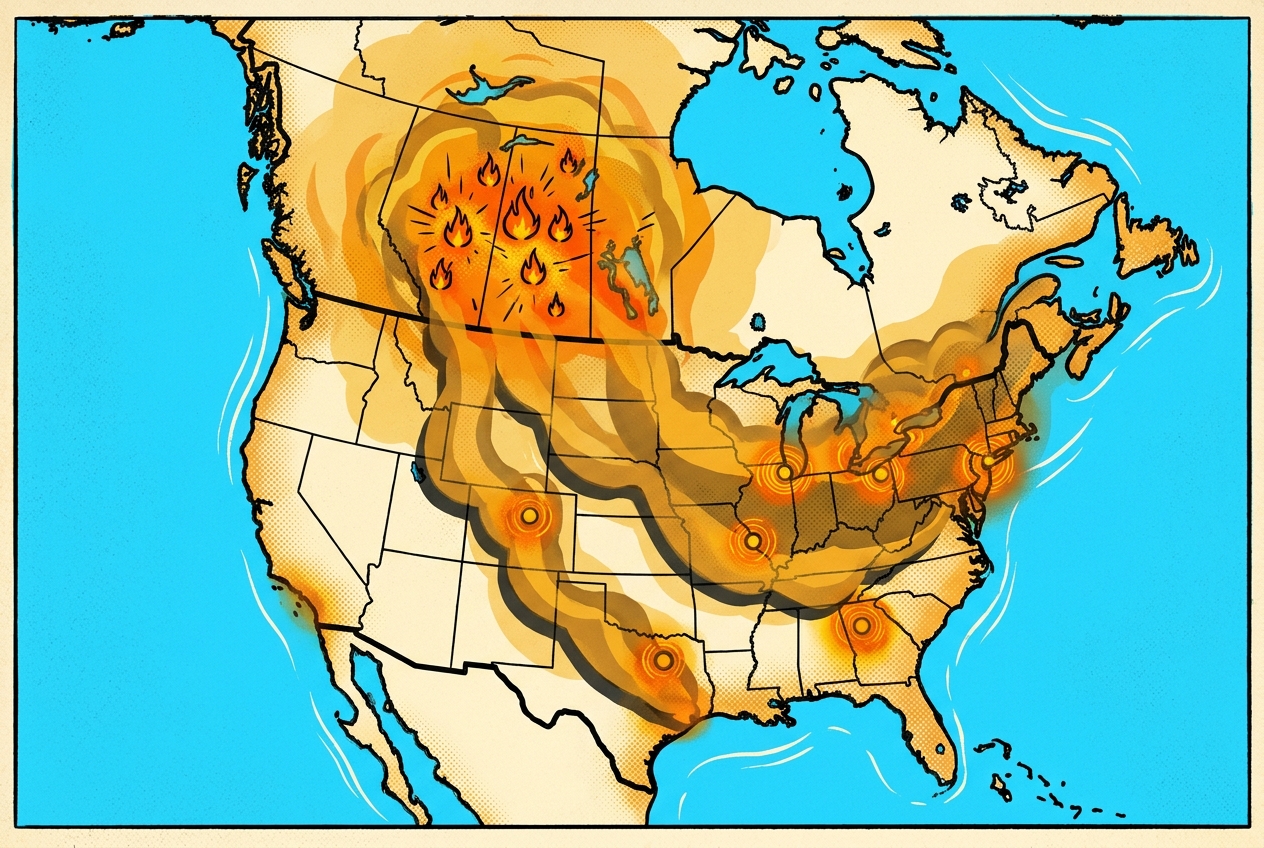
As of the middle of July 2026, roughly 900 wildfires are burning across Canada, and more than 120 of them are classed as “out of control” — fire-service shorthand for a blaze nobody expects to stop spreading on its own. The smoke from those fires has poured south across the border and settled over the Great Lakes, the Midwest and the Northeast, dragging more than a hundred million people into air their local health department would tell them to stay out of.
In a few cities it got genuinely ugly. Detroit, Milwaukee and Toledo all logged Air Quality Index readings above 500 on the worst afternoon — the top of the scale, well past the 300 line where the government simply calls it “hazardous” and stops adding adjectives. It got bad enough that people spent the week asking whether the smoke would reach a stadium on the East Coast and mess with the World Cup final. That's where we are.
What's actually on fire
Most of this is Canada's boreal forest — the enormous belt of spruce, pine and peat that runs across the top of the country. It is built to burn; fire is part of how that ecosystem resets. What has changed is the dial. Hotter, drier springs cure the forest into kindling earlier, lightning and the occasional careless human light it, and once a peat fire gets going it can smoulder for weeks. This July the biggest clusters have been in the boreal north and, closer to home for a lot of Americans, right along the Ontario–Minnesota border.
You don't need to live near any of it to breathe it. That's the part people find hard to accept.
Why your city got smoked from a thousand kilometres away
Wildfire smoke is mostly PM2.5 — fine particles smaller than 2.5 microns, roughly a thirtieth the width of a human hair. Particles that small don't fall out of the sky politely. They loft high into the atmosphere, catch the same west-to-east winds that steer your weather, and travel for days. A fire in northern Ontario on Monday is a hazy Thursday in Ohio. When a weather system parks the wind in the wrong direction, the plume stops moving and just sits on top of you, which is exactly what turned this week's numbers so grim in the eastern Great Lakes.
What the number on the app actually means
The Air Quality Index is a 0–500 scale, and during a smoke event it's driven almost entirely by PM2.5. Here's the honest version of the ladder, without the sugar-coating:
“Unhealthy for sensitive groups” is the line worth watching, because sensitive groups is a bigger club than most people think: kids, pregnant people, anyone over about 65, and anyone with asthma, COPD or a heart condition. If that's your household, 101 is your number, not 151.
We built ToClearSkies around a second way of feeling that number, because “154 micrograms” doesn't land the way it should. A day spent breathing this week's Detroit air is, in health terms, a bit like smoking several cigarettes — not because there's tobacco in the sky, but because that's roughly the dose of fine particles you'd take in. We walk through exactly how that maths works on our methodology page. It's a rough yardstick, and it's a useful one.
“How long is this going to last?”
The frustrating, true answer: as long as the fires burn and the wind points at you. Those are two different clocks. The fires themselves won't be fully out until the season turns — realistically, autumn rain and snow. But the smoke over any given city comes in waves, not one continuous blanket. A plume arrives, the wind shifts, the air scrubs clean for a day or two, and then the next plume rolls in. That's why the forecast matters more than the fire map: on a smoke day, conditions can swing a full AQI category between morning and evening.
So don't plan your week off a single reading. Check it the way you'd check rain — today's number, tonight's, tomorrow's.
What to do while you wait it out
Nothing here is exotic. It's just the stuff that actually moves the needle.
- Check the live reading before you go out, not after. Use AirNow in the U.S. or Environment Canada's AQHI, and trust the forecast tab.
- Shrink your outdoor time when it's bad. Move the run indoors, skip the yard work, and keep hard exercise for a clean-air day — you breathe far more air, far deeper, when you're working hard.
- If you must be out in it, a well-fitted N95 or KN95 helps (for adults — more on why that doesn't extend to babies in our piece on little lungs). A cloth or surgical mask does close to nothing for smoke.
- Seal and filter indoors. Close the windows, run the AC on recirculate, and if you have a portable HEPA air purifier, this is the week it earns its keep. No purifier? A box fan taped to a MERV-13 furnace filter is a genuinely effective stopgap that the EPA itself recommends.
- If your whole area is socked in, look at what's within a drive. Smoke is patchy. A town two hours up the highway can be sitting in clean blue air while your city chokes. That's the entire reason this site exists.
Wildfire smoke feels like weather you just have to accept. Some of it is. But a lot of your dose is decided by small choices — when you go out, how well you seal a room, and whether you know there's cleaner air an hour away. You have more say than the orange sky suggests.
Sources & further reading. Fire counts, affected-population estimates and the 500+ AQI readings for Detroit, Milwaukee and Toledo are drawn from mid-July 2026 reporting by CNN,The Washington Post and NBC News. AQI categories follow the U.S. EPA's AirNow. The cigarette equivalence follows Berkeley Earth; we explain our version on the methodology page.
This article is general information, not medical or emergency advice, and the situation it describes changes by the hour. For decisions about your health, follow AirNow, Environment Canada and your local public-health authority.