Forget the Whole House. Seal One Room.
Filtering an entire home is expensive and often impossible. Sealing and filtering one room — the move the EPA actually recommends — clears the air where you sleep for the price of a box fan.
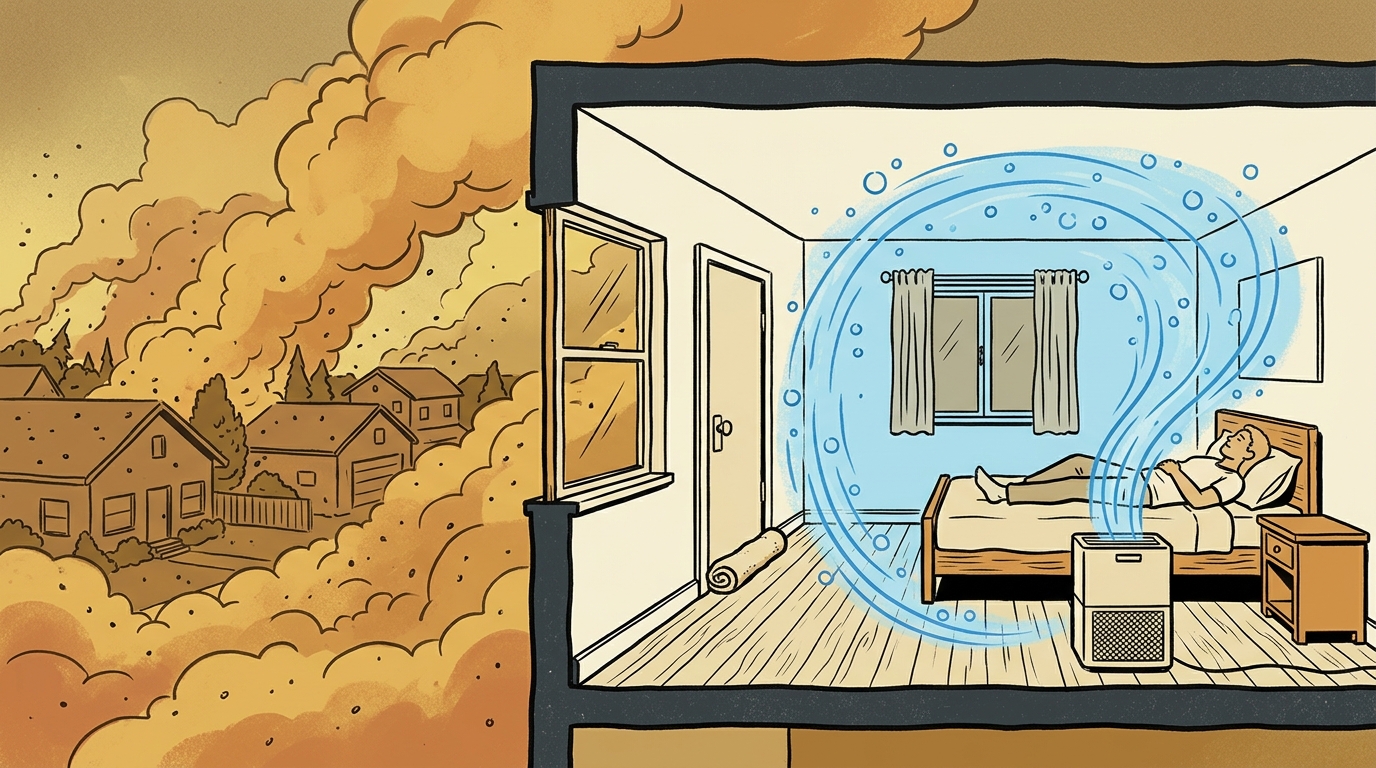
Don't try to filter your whole house during a smoke event — filter one room instead. Pick the smallest room with the fewest windows and doors where someone actually spends hours (a bedroom is usually it), seal it up, and run a HEPA purifier or a $40 DIY box fan filter inside. One well-sealed, well-filtered room beats a whole house of thin, half-filtered air.
The short version
- Pick the smallest room people actually occupy for hours — usually a bedroom — with the fewest windows and doors.
- Seal it: windows shut, a towel or weatherstripping at the door gap, HVAC set to recirculate (or off), and the room's supply damper closed if it has one.
- Filter it: a right-sized HEPA purifier, or a $30-40 Corsi-Rosenthal box — MERV-13 furnace filters taped around a box fan, a design the EPA has tested.
- Nothing that makes particles goes inside the room: no frying, candles, vacuuming, smoking, or incense.
- Run it continuously for the whole event; only open the room back up once outdoor AQI drops and stays down.
Which room should you turn into the clean room?
Smaller wins. A smaller room means fewer cubic feet of air for your filter to clean, so it clears faster and holds a lower PM2.5 level for the same purifier or fan. Count the openings, too — every window, door, and vent is a path for smoke to leak back in, so the room with the fewest of them seals easiest.
Within those constraints, pick the room people are actually in for hours: a bedroom, almost always, since everyone in the house sleeps somewhere. A room nobody uses doesn't protect anybody, no matter how well it seals. If someone in the household is at higher risk — an infant, someone pregnant, or a person with asthma or heart or lung disease — their bedroom is the one to seal first.
How do you actually seal a room against smoke?
Close every window and exterior door in the room, and check for anything propped open for air. Push a rolled towel against the gap under the door — that gap is often the single largest opening smoke uses to get in from the rest of the house. If you have adhesive weatherstripping on hand, run a strip along the door frame; it's a five-minute job that outlasts the towel.
Then deal with the HVAC. If your system has a "recirculate" setting, use it — it stops pulling in outside air. If it doesn't, or you're not sure, turn the system off for the room instead of leaving it running on fresh-air intake. If the room has its own supply damper or vent you can close, close it; running your own filter inside the room does more good than a duct still pushing smoke-laden outside air into it.
Store-bought purifier or the DIY Corsi-Rosenthal box?
Either works — the choice comes down to noise tolerance and whether you'd rather buy or build. A HEPA purifier sized to the room (CADR at least two-thirds of its square footage — the full sizing math is in how to size a purifier for your home) is the quieter, tidier option. The Corsi-Rosenthal box — four or five MERV-13 furnace filters taped into a cube around a box fan, facing inward — costs about $30-40 in parts, takes fifteen minutes to build, and the EPA has tested the design and found it competitive with purifiers costing several times as much.
| Option | Cost | Typical smoke CADR | Noise | Availability |
|---|---|---|---|---|
| HEPA purifier | $150-400 | 150-250 cfm | Quieter on low; loud at the speed that hits full CADR | Buy online or in store, ready to run |
| Corsi-Rosenthal box | $30-40 in parts | 200-450 cfm | Louder — a box fan on high, no acoustic dampening | Build it yourself; parts sell out fast during a bad smoke week |
A closed door and a running filter do more for your lungs than any whole-house claim on a purifier box.
What should never happen inside the clean room?
Anything that puts particles into the air undoes the sealing and filtering you just did. That means no frying or cooking, no candles or incense, no smoking or vaping, and no vacuuming (even HEPA-filtered vacuums stir up dust while running). Keep the room's job singular: it's for sitting, sleeping, and breathing, not for chores or cooking that happen to be indoors.
How long do you run it, and when do you open the room back up?
Continuously, for as long as outdoor air is bad — that means the purifier or box fan stays on and the door stays shut for the duration of the smoke event, not just at night. Every time the door opens, smoke-laden air from the rest of the house mixes back in, so treat door-opening as a cost, not a free action.
Reopen the room once your outdoor AQI number drops back into the "Good" or "Moderate" band and stays there — not just for one clean-looking hour, which can be a lull before the smoke returns. Check your city's live number before you decide the event is actually over.
Sources & further reading. EPA, "Create a Clean Room to Protect Indoor Air Quality During a Wildfire"; CDC, "Creating a Clean Room"; EPA, "Air Filters and Air Cleaners" (MERV ratings); Clean Air Crew, Corsi-Rosenthal box build instructions.
This article is general information, not medical advice. If you or someone in your household has a heart or lung condition, is pregnant, or is having trouble breathing, talk to a doctor about smoke exposure specific to your situation.
Common questions
Do I need to seal a room if I already run an air purifier?
Yes. An unsealed room keeps trading its clean air for smoky air from the rest of the house through door gaps and vents, so the purifier is stuck refiltering air it just cleaned. Sealing is what lets the purifier's CADR actually win.
Is a Corsi-Rosenthal box as good as a HEPA purifier for a clean room?
Often better on cost-per-CADR — a $30-40 box fan with MERV-13 furnace filters taped around it can move more clean air per minute than purifiers costing several times as much, and the EPA has tested the design. It's louder and bulkier, which is the main tradeoff.
Can I use a living room as my clean room instead of a bedroom?
You can, but a bedroom usually wins: people spend more consecutive hours there, and bedrooms tend to have fewer windows and doors than a living room, which makes sealing easier.
When is it safe to stop running the clean room and open it back up?
Once outdoor AQI drops into the Good or Moderate band and stays there for several hours, not just one clean-looking reading — smoke plumes can dip and return within the same day.