What a Week in Cleaner Air Changes (and What It Doesn't Prove)
Leaving smoke lowers your measured PM2.5 exposure while you're away. No study has tested whether that changes a health outcome. Here's the exposure math and a four-factor way to decide.
The short answer
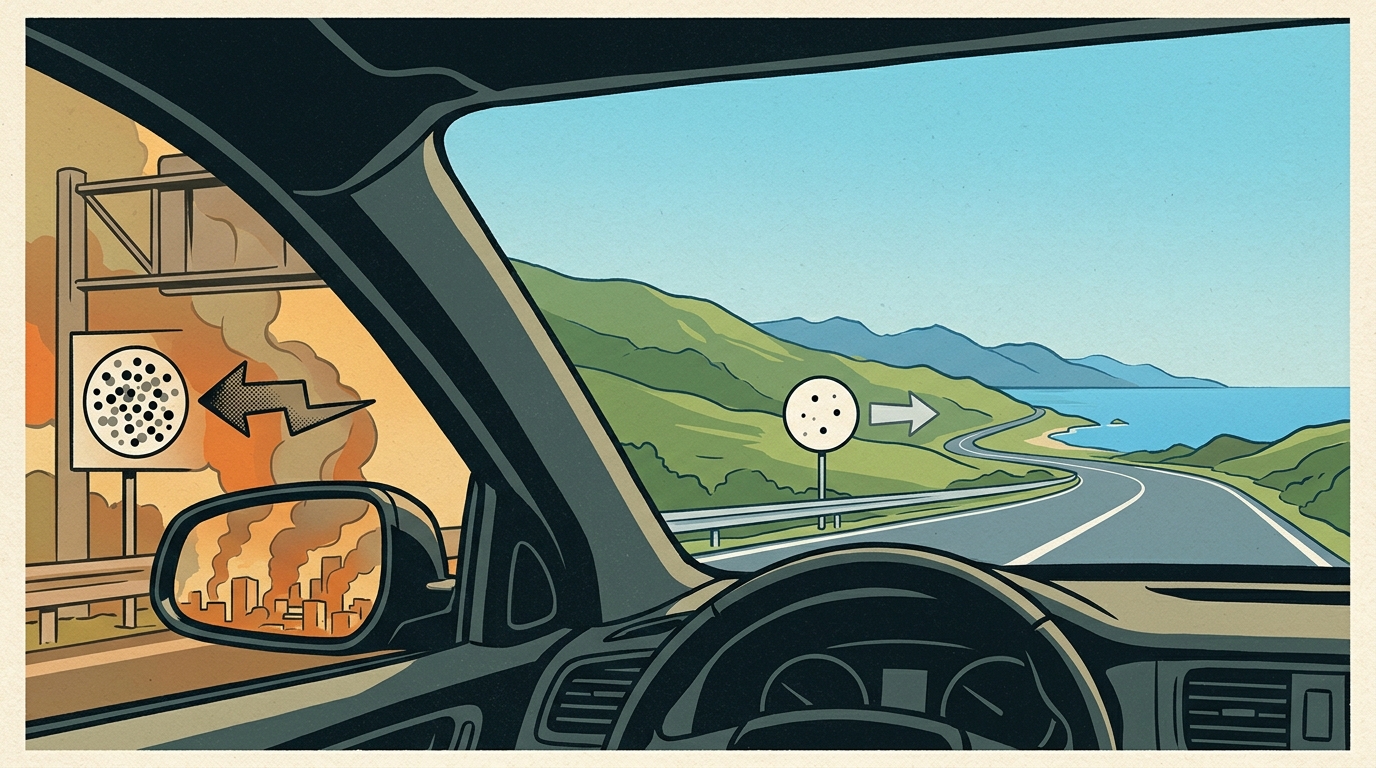
Moving to air with a verifiably lower PM2.5 reading reduces the smoke you breathe while you're there, provided your outdoor time and activity level stay roughly the same. That's a measurable fact about the air. Whether a week away changes a specific health outcome, including a heart attack, a hospitalization, or a flare-up of an existing lung or heart condition, has not been directly tested. No study has assigned people to leave or stay during wildfire smoke and tracked what happened to their health afterward.
Related research, and its limits
The exposure principle isn't in dispute: fewer particles in the air you breathe means fewer particles reach your lungs, for as long as the concentration difference holds. That's not the same as a proven health benefit. Three studies come closest: pollution drops during the 2008 Beijing Olympics measured against blood biomarkers of inflammation and clotting in healthy young adults (Rich et al., 2012, JAMA); a randomized crossover trial of indoor air purifiers measuring blood pressure and cardiovascular biomarkers (Chen et al., 2015, JACC); and a randomized crossover trial of particulate-filtering respirators measuring blood pressure and heart-rate variability (Shi et al., 2017, EHP). Samples ran 24 to 125 healthy young adults, the pollution studied was urban rather than wildfire smoke, and none tracked disease, hospitalization, death, or travel. For the study-by-study breakdown, see our Evidence Desk review.
The exposure math, and what it doesn't mean
To make the exposure difference concrete, ToClearSkies converts a PM2.5 concentration into a weekly cigarette-equivalent figure: micrograms per cubic meter, divided by 22, multiplied by 7. Details at our methodology page. Run it on a smoke-heavy week assumed to average 150 µg/m³ against a clean week assumed to average 12 µg/m³, both figures treated as sustained weekly-average concentrations for this example: about 48 weekly equivalents versus about 4, a gap of roughly 44. That gap compares ambient particle mass between two hypothetical readings, not the dose you personally inhale. It's not a toxicological or health-risk equivalence, and a week of smoke should never be described as "smoking" a pack or a carton. Use it to weigh two air-quality readings against each other, not to estimate personal harm.
Four questions that decide whether a trip is worth it
- How long will the smoke last? A short smoke event gives you fewer hours of avoided exposure and less time to offset the fixed costs of travel: packing, missed work, expense. A forecast showing a week or more of persistent smoke shifts that tradeoff. Check persistence at how to read a smoke forecast.
- How much cleaner is the destination, verified in real time? Compare your current reading against the destination's current reading at the live map the day you decide, and again the day you leave, since plumes shift.
- Who is in your household? EPA guidance identifies infants, pregnant people, older adults, and anyone with existing heart or lung disease as higher-risk from smoke exposure generally. That status changes how much weight your household puts on a given exposure reduction, not the measured concentration gap between two locations. Weigh this at who is most at risk from wildfire smoke.
- What does the trip cost you? Missed work or school, travel expense, and the disruption of relocating are certain costs, weighed against an exposure reduction whose clinical payoff is unproven.
Limitations
This is a decision framework, not medical advice, and travel is not a treatment. What would change this conclusion is a direct prospective or randomized study that relocates people during wildfire smoke and measures symptoms or clinical outcomes; none exists yet. EPA guidance discusses cleaner-air shelters and temporary relocation for situations where clean air can't be maintained at home, but takes no position on whether a one-week trip changes health outcomes. This review reflects evidence available as of July 21, 2026.
Cigarette-equivalent heuristic from Berkeley Earth. Wildfire smoke guidance from EPA/AirNow.