Leaving lowers your exposure right away. Whether it changes a health outcome is unsettled.
Short pollution reductions shift some biomarkers within days. No study has tested whether a week away from wildfire smoke prevents a clinical event.
Evidence snapshot
Structured synthesis, not a systematic review or a numerical score.
- Grade
- Preliminary
- Sources assessed
- 5
- Evidence base
- 3 intervention studies · 1 burden model · EPA guidance
- Reviewed through
- July 21, 2026
Every wildfire season brings the same question: if smoke sits over your area for a week, is it worth leaving? The exposure math is simple. Move to air with less PM2.5 and your inhaled dose drops in rough proportion to how much cleaner it is there. Whether that lower dose changes a health outcome you'd notice, or one that would show up in a medical record, is a separate and much less settled question.
What we think
Leaving a sustained, confirmed smoke event for genuinely cleaner air is a defensible exposure-reduction choice for many households. It should be described honestly: reduced smoke exposure, not a medical treatment or protection against a specific illness. The supporting biology is plausible and points in a consistent direction, but it comes from small, indirect studies that never tested anyone leaving wildfire smoke.
The one thing we know directly
Moving from smoke-heavy air to lower-PM2.5 air reduces your measured exposure. That part isn't in dispute. What counts as "cleaner" changes hour to hour, so compare current outdoor readings at your location against candidate destinations on ToClearSkies' live map before treating any trip as a real reduction. A place that looked clean in the morning can fill with smoke by afternoon.
The chain of indirect evidence
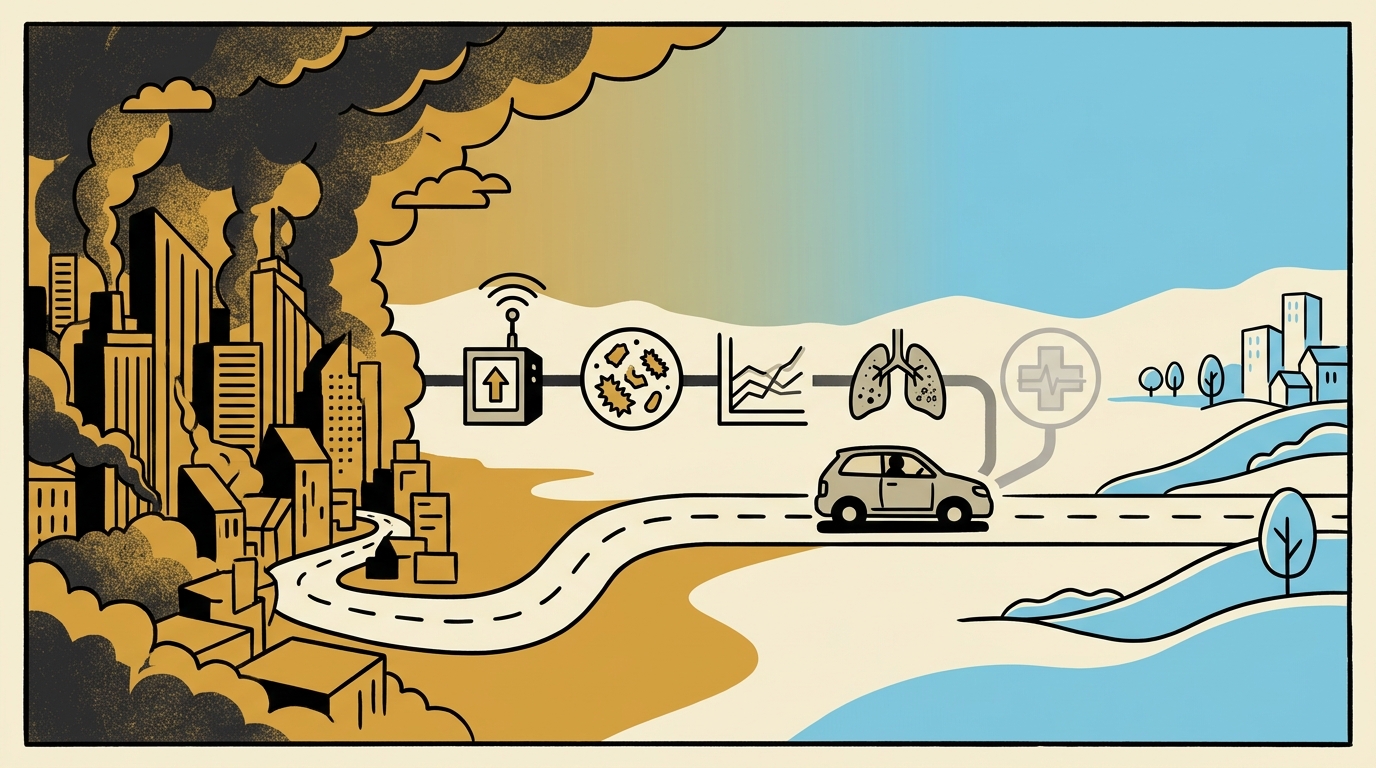
No study has randomized people to leave or stay in wildfire smoke. What exists is a short chain of studies on other kinds of short-term pollution reduction, each showing a biological signal without testing a real-world outcome.
| Study | Population | Exposure change | Duration | Result |
|---|---|---|---|---|
| Rich et al., 2012 | 125 healthy young adults | Beijing Olympic controls cut pollution 13%–60% | Several weeks | Two thrombosis-related biomarkers improved past a strict statistical threshold; most other measures were not significant, and the authors called the clinical meaning uncertain |
| Chen et al., 2015 | 35 healthy students | Air purifiers, crossover design; PM2.5 fell 57% | 48 hours | Blood pressure and several biomarkers shifted |
| Shi et al., 2017 | 24 healthy adults | Respirator masks, crossover design | 48 hours | Blood pressure and heart rate variability changed while masked |
The direction is consistent across all three: cutting pollution exposure for a day or two moves blood pressure and a handful of clotting- and rhythm-related markers in healthy adults. None involved wildfire smoke, none involved multi-day relocation, and none followed anyone long enough to see whether the biomarker shift changed a real health event.
Where the chain breaks
Zhang and colleagues (2025) modeled population-wide exposure and attributable mortality from the 2023 Canadian wildfire smoke that covered much of North America. That work quantifies scale at a population level using statistical modeling; it does not test what happens to one person who leaves for a week, and treating its numbers as evidence about an individual traveler's outcome would overstate what the study supports. The EPA's wildfire smoke guide for public health officials recommends cleaner-air shelters and temporary relocation for sustained severe events, a reasonable exposure-reduction recommendation, but it doesn't attach a quantified individual health benefit to a specific one-week trip. That number doesn't exist in the published literature. This is why the grade here stays Preliminary rather than Moderate: the mechanism is plausible and consistent, but nothing in this evidence base has been tested on the population, pollutant, or duration people are really asking about.
When leaving is still a rational choice
Four things matter more than any single study here:
- Forecast persistence. A trip only makes sense if the smoke is expected to hold for days, not clear tomorrow. See how to read a smoke forecast for judging that.
- Exposure difference. The destination needs to be meaningfully, not marginally, cleaner, confirmed against current readings rather than assumed from distance alone.
- Household vulnerability. Asthma, heart disease, pregnancy, and young children in the household can change how heavily someone weighs a confirmed exposure reduction against the cost of a trip; that weighing is personal and isn't a substitute for individualized medical advice.
- Trip cost. Time, money, and disruption are real costs to weigh against an exposure reduction that is genuine but not a guaranteed clinical benefit.
Limitations
- No trial has randomized people to leave or stay during wildfire smoke.
- The supporting biomarker studies used masks or filtration against urban pollution, not wildfire smoke, in small groups of healthy young adults.
- Biomarker and blood pressure shifts do not establish fewer hospitalizations, heart attacks, or deaths.
- The 2025 mortality modeling estimates population-level burden, not individual outcomes from relocation.