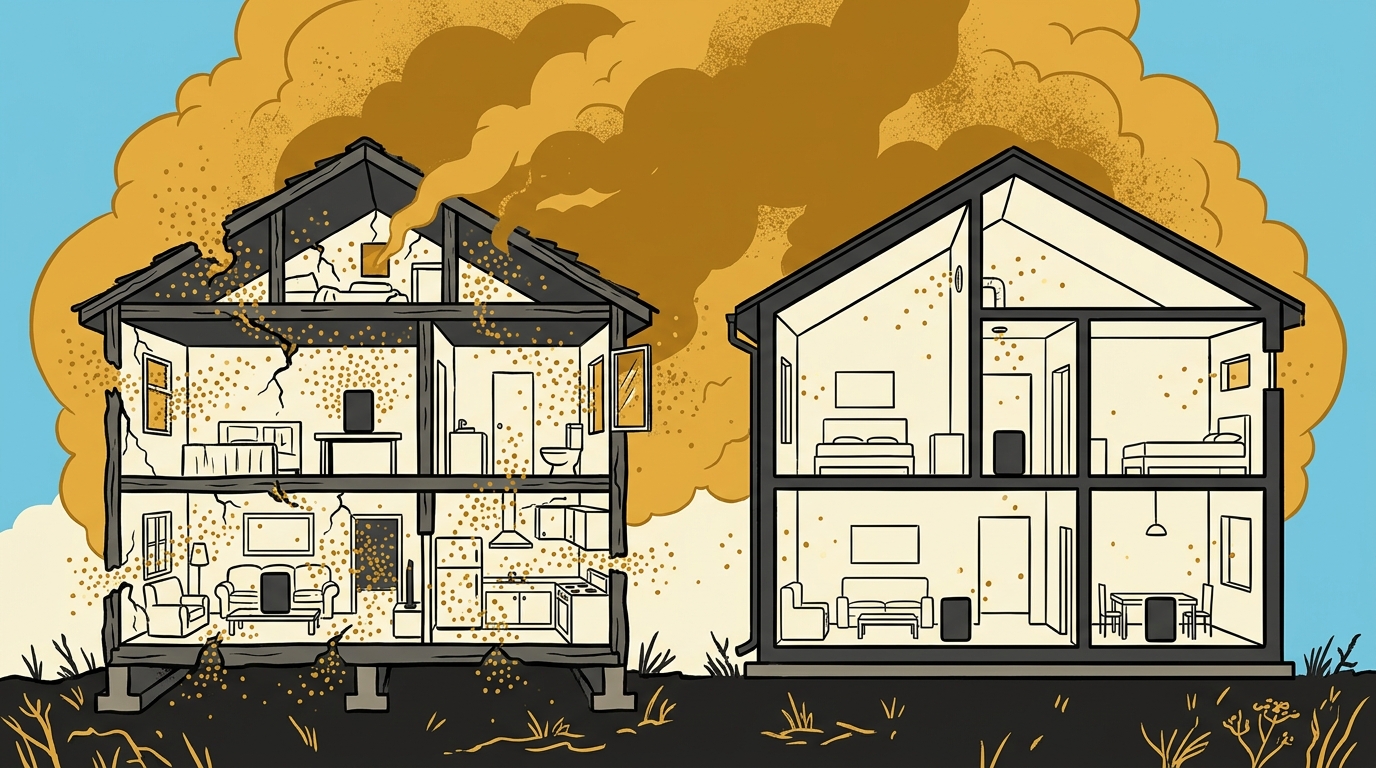
Closing your windows helps. It doesn't seal you off.
Indoor PM2.5 during smoke events depends on your building, not a fixed percentage.
Evidence snapshot
Structured synthesis, not a systematic review or a numerical score.
- Grade
- Moderate
- Sources assessed
- 5
- Evidence base
- 3 field studies · 1 review · EPA guidance
- Reviewed through
- July 21, 2026
What we think: A wildfire smoke event pushes outdoor PM2.5 up by a large multiple, and even a well-sealed home only slows that surge; it doesn't cancel it. The same studies that show indoor air improving on a percentage basis also show indoor concentrations climbing sharply in absolute terms. The number that matters is what your own room measures, not what a study average suggests it should be.
The ratio drops. The exposure doesn't.
The infiltration ratio measures how much of the PM2.5 inside a building traces back to an outdoor source, relative to the outdoor concentration at the time. It filters out indoor sources like cooking or candles, isolating what comes through the walls and cracks. In a study of more than 1,400 California buildings monitored through PurpleAir sensors, the geometric mean infiltration ratio fell from about 0.4 on non-fire days to about 0.2 on wildfire-smoke days (Liang et al., 2021). Households kept out a larger share of outdoor smoke during fire events than on ordinary days, likely from closed windows and running AC, though the study can't confirm which behavior did the work.
That drop in ratio reads as protection. On its own, it isn't. Mean indoor PM2.5 in those same buildings, over the same wildfire days, nearly tripled. Outdoor concentrations during smoke events rose by a far larger factor than the ratio fell, so half the entry rate applied to several times the outdoor load still produced a much higher indoor number. A shrinking fraction and a rising exposure are two separate facts, and only the second one affects your lungs.
Why one home fills with smoke and the next doesn't
The same dataset found lower infiltration ratios in newer buildings and in homes running air conditioning or filtration equipment. Tighter construction slows the exchange of indoor and outdoor air; mechanical filtration removes particles from air already inside. A 2026 review of wildfire infiltration risk factors describes the same variables; building envelope, HVAC operation, window and door habits; as the split between low- and high-infiltration homes (Bolden et al., 2026). That review synthesizes prior work rather than measuring anything new, so treat it as a frame for the measured studies, not as independent data.
A 36-home study in King County, Washington modeled indoor PM2.5 across its sample and found wildfire-smoke periods associated with a 72.6% higher indoor level than clean periods, after adjustment (Teigen et al., 2026). That figure describes the group, not any one household: homes in the sample varied widely, some tracking outdoor smoke closely and others staying comparatively insulated. A separate study of low-income households in Colorado during wildfire season documented outdoor pollution reaching indoor air in that housing stock (Shrestha et al., 2019), without measuring sealing or filtration directly; it can show that smoke got in, not why that home's envelope let it.
Measure before you decide
None of this tells you what your specific home is doing right now. Building age, HVAC mode, a door left open for a delivery, wind direction: all of it moves the number hour to hour, which is why an infiltration ratio measured last wildfire season describes that season, not a guarantee for this one. ToClearSkies reports outdoor monitor and modeled readings for your area; it does not measure the air inside your walls. If you want your actual indoor exposure during a smoke event, you need an indoor PM2.5 monitor in the room you spend time in, not an assumption borrowed from a study average.
Once you have that number, the response is straightforward: close windows and doors, set HVAC systems to recirculate where the system supports it, and run portable filtration or a high-efficiency filter in the room you're using (EPA AirNow Wildfire Smoke Guide). Closing the building slows how fast smoke enters. Filtration removes particles once they're inside; closing up without filtering leaves the smoke that's already indoors right where it is. For a step-by-step setup, see how to make one clean room.
Limitations, briefly
- The largest dataset relies on PurpleAir, a sensor network installed by owners who chose to buy one; whether that sample-selection skews the geometric mean ratio higher or lower than a random sample of housing is not established.
- Sample sizes outside that dataset are small: 36 homes in King County, a limited Colorado sample. Enough to confirm the direction of the effect, not to fix a precise number.
- The 72.6% figure is a group-level, model-adjusted association across a sample, not a prediction for any single household.
- Infiltration changes hour to hour with windows, HVAC settings, and occupant behavior; none of these studies capture a fixed property of a building.