Portable filters cut indoor smoke particles reliably. Proof they stop illness is still thin.
What's measured, what's modeled, and what remains untested about wildfire smoke filtration.
Evidence snapshot
Structured synthesis, not a systematic review or a numerical score.
- Grade
- Moderate
- Sources assessed
- 5
- Evidence base
- 2 intervention studies · 1 model · 2 agency guides
- Reviewed through
- July 21, 2026
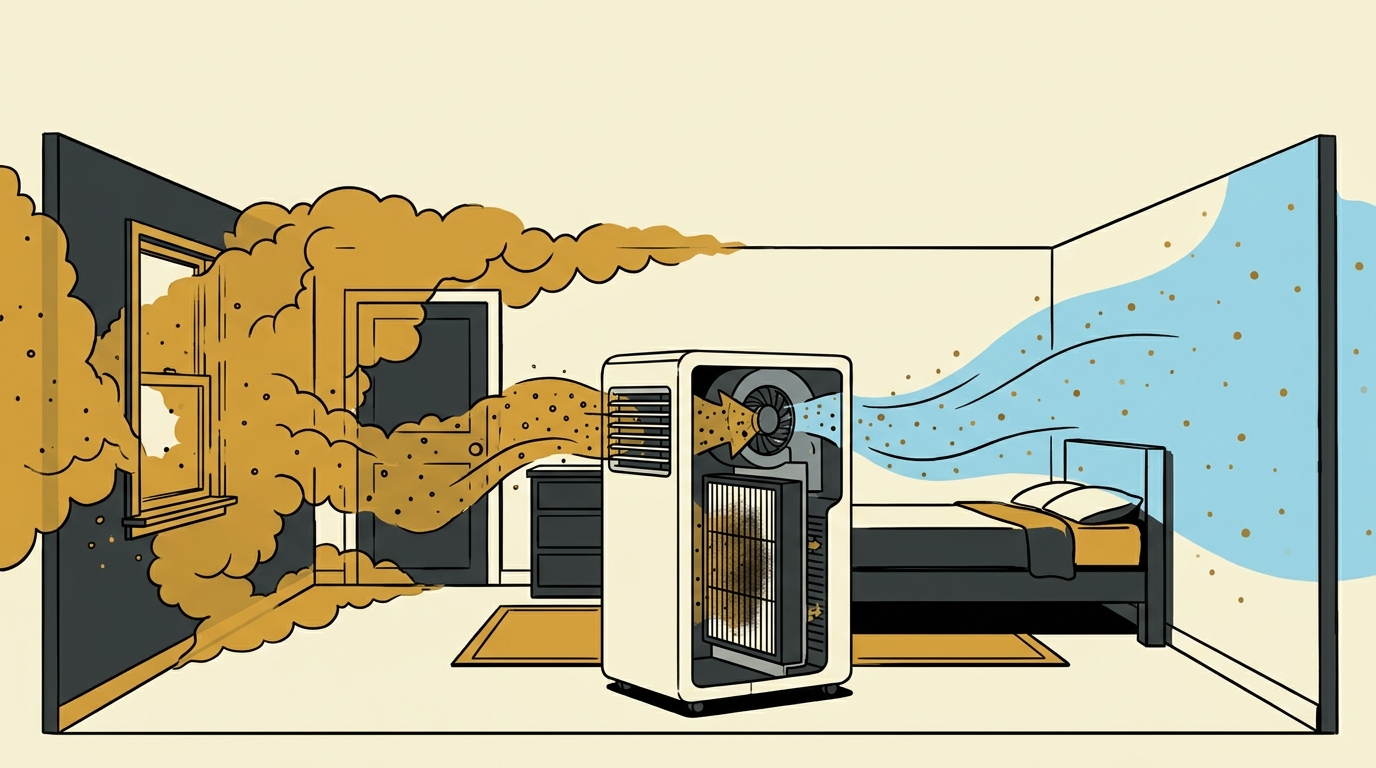
Filtration lowers indoor PM2.5. The EPA recommends portable air cleaners and DIY filters specifically for wildfire smoke. But direct clinical evidence, and evidence gathered during a major smoke event itself, is limited; the two intervention studies behind this claim were run under ordinary conditions, not inside an active wildfire.
What we think: the exposure-reduction claim is solid enough to act on. A field study and a controlled trial, in different populations, both found real filtration removes more indoor particulate than no filtration or a sham device. The EPA's own guidance for wildfire smoke rests on that same physics. What's missing is the next link in the chain: proof that lower indoor PM2.5 during a smoke event translates into fewer asthma attacks, ER visits, or other adverse outcomes. That link hasn't been tested, so treat filtration as a real exposure reduction, not a guaranteed health shield.
The narrow claim that is proven
Strip the marketing language away and the provable claim is narrow: a HEPA unit or a well-built DIY box-fan filter, sized to its room and run continuously, removes airborne particles faster than an unfiltered room clears them on its own. Two independent lines of research back that up, using different methods, different populations, and different pollution sources; and they still land on the same direction of effect. That consistency is what earns this claim real support. It does not, on its own, tell you what happens to a person's health when they breathe cleaner air during a smoke event.
Two very different measurements
A two-year field study of 36 households in King County, Washington, tracked indoor and outdoor PM2.5 continuously and rotated households through HEPA, DIY, and no-filtration periods (Teigen et al., 2026). After adjusting for outdoor PM2.5, HEPA use was associated with 12.7% lower indoor PM2.5, and DIY filtration with 7.54% lower indoor PM2.5. The monitoring itself spanned both ambient air and smoke periods over the two years, but the assigned intervention windows (the stretches when a given household was running HEPA, DIY, or nothing) did not happen to coincide with a major smoke event. The intervention order was fixed rather than randomized, compliance was assumed rather than verified, and much of the variability in results went unexplained. A tighter test came out of Shanghai: a randomized, double-blind crossover trial gave 35 healthy college students real or sham purifiers for 48 hours each, then swapped them (Chen et al., 2015). Indoor PM2.5 fell 57%, alongside changes in several blood biomarkers and blood pressure. That's a much larger effect than either King County figure, and the gap is the point: a sealed comparison over two days in urban pollution will always show a cleaner result than a real household running a filter on its own schedule through good-air and worse-air days alike. Neither number is wrong. They're measuring different things; a controlled short-term swap against Shanghai's ambient urban pollution, versus messy, extended real-world use in a Pacific Northwest county whose smoke periods never lined up with the study's own intervention windows.
The health-outcome gap
This is where the evidence runs out. The Shanghai trial's biomarker and blood pressure changes are real measurements, but a shift in a blood marker over 48 hours doesn't establish that anyone avoided a heart attack or an asthma flare-up down the line; biomarkers are a proxy, not an endpoint. Fisk and Chan (2017) modeled the population-level health and cost benefits of wildfire filtration, which is useful for agencies deciding whether to fund filter distribution; but it is a projection built on assumed exposure-response relationships, not a record of people who used filters and got sick less often. No source here tracked asthma attacks, ER visits, or cardiovascular events tied to filter use during an actual wildfire. That gap is why this claim is graded Moderate rather than Strong. Strong would require multiple direct sources converging on the same real-world health outcome, with little room left to reverse the conclusion. What exists instead is consistent evidence that filters remove particles, plus a model of what that reduction might be worth, plus agency guidance recommending the practice anyway. Reasonable, but short of proof that using a filter during a wildfire prevents illness.
A buying decision the evidence can support
The EPA recommends portable air cleaners and DIY box-fan filters for wildfire smoke, and separately warns against devices that intentionally generate ozone, since ozone irritates lungs on its own regardless of any particles it happens to remove (clean room guidance; air cleaner guidance). That guidance is built on the same particle-removal research above, not a new outcome trial, but it supports a practical buying rule: match Clean Air Delivery Rate to room size. Our purifier sizing guide walks through that math. Run the unit continuously rather than intermittently, since the King County study couldn't separate how much of its smaller real-world effect owed to use patterns versus timing. Set it up as part of a single sealed room rather than trying to filter an entire house; our clean-room setup guide covers that part. Skip ionizers and ozone generators for this use.
Limitations
Both PM2.5-reduction studies used small samples (36 households and 35 students), and neither directly measured intervention performance during an active wildfire smoke event. Direct health-outcome data for filtration during real wildfire smoke is thin across the field generally; that's a gap in the underlying science, not something this review uncovered that others missed.