The N95 rating is a certification, not a promise about your specific face.
A NIOSH-approved N95 meets a filtration standard. What you breathe depends on fit, leakage, wear time, and evidence that is still mostly indirect.
Evidence snapshot
Structured synthesis, not a systematic review or a numerical score.
- Grade
- Moderate
- Sources assessed
- 6
- Evidence base
- 3 intervention/fit studies · 1 model · 2 agency guides
- Reviewed through
- July 21, 2026
N95 is a NIOSH certification under 42 CFR Part 84, covering the complete respirator design, not a swatch of filter media on its own. To earn the label, the approved respirator has to demonstrate at least 95% filtration efficiency against a specified non-oil test aerosol under NIOSH's certification protocol. That number describes performance in a controlled lab test. It does not promise a 95% cut in what you personally inhale during a wildfire event. An adequate face seal and correct use determine the protection you get, and that depends on your particular jawline, glasses, facial hair, and how long you keep the mask on. This article covers three separate questions that get collapsed into one: does the filter work, does the mask seal to your face, and does wearing one long enough change your health.
What we think
The filtration mechanism behind N95 respirators is solid and well understood. What's thinner is the jump from "the approved respirator filters well in certification testing" to "wearing one during smoke events prevents a measurable amount of illness." Most of the wildfire-specific health numbers come from models that assume good fit and consistent wear, not from trials that counted hospitalizations with and without masks. We rate this Moderate: a real mechanism with strong lab support, held back by a fit-and-leakage problem that determines your exposure reduction, and by a clinical evidence base built on ordinary urban air pollution rather than wildfire smoke. For how N95 compares to KN95 and other mask standards, see N95 vs. KN95 for wildfire smoke.
Filter: what the certification tests
NIOSH's 42 CFR Part 84 certification evaluates a complete respirator design, and the N95 designation requires the approved respirator to filter at least 95% of a specified non-oil test aerosol under that protocol. This is why N95s outperform cloth masks or loose surgical masks against wildfire PM2.5: electrostatically charged filter media traps fine particles by diffusion and interception, a mechanism confirmed across decades of testing. Both the NIOSH wildfire guidance and the EPA wildfire smoke guide recommend NIOSH-approved N95 or P100 respirators for adults who cannot avoid being outdoors during smoke events. Both note the respirators reduce particle exposure only when correctly selected and worn, with added limitations for children and people with certain health conditions who may not get a reliable fit or tolerate wearing one for long stretches. Neither agency treats the certification as covering gases or vapors; smoke's gas-phase components pass through regardless of mask rating.
Face: fit and leakage decide your exposure
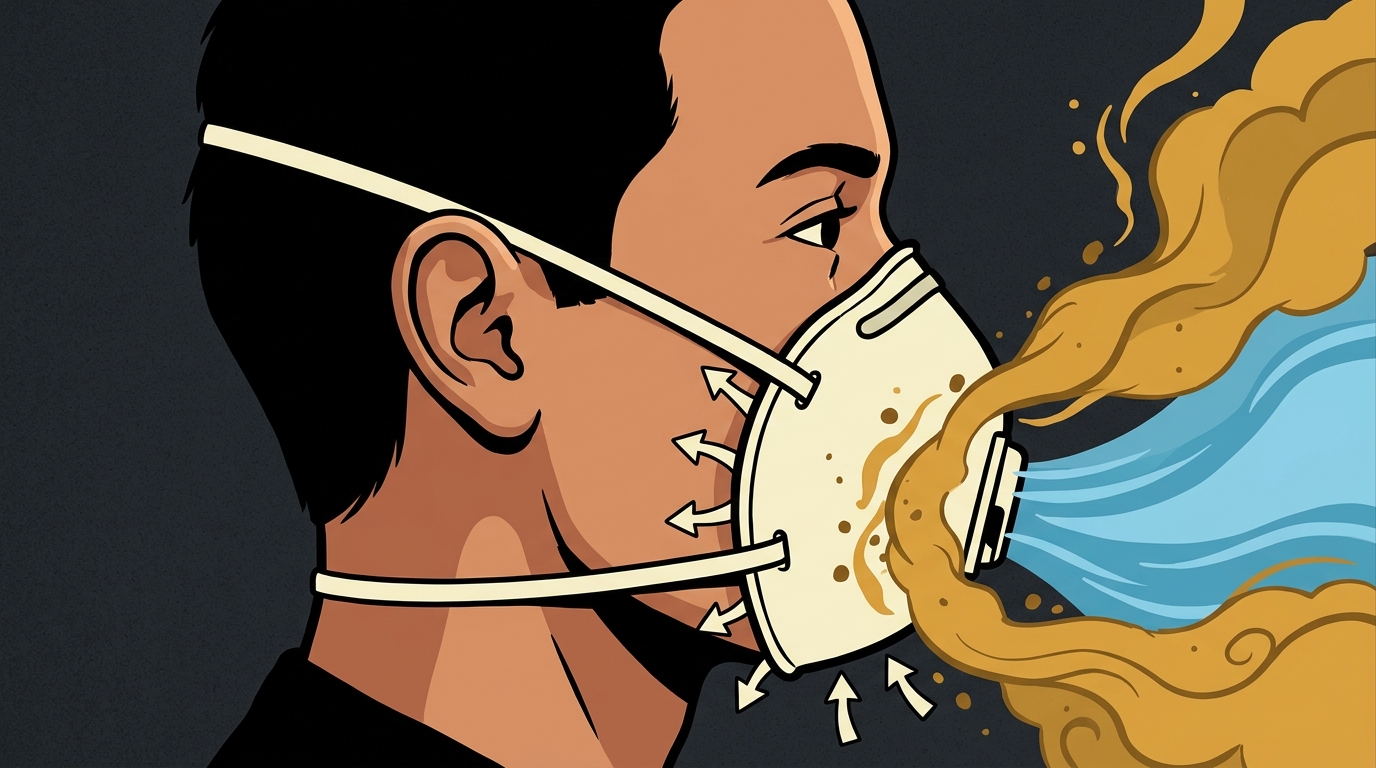
The certification's filtration figure comes from a standardized test protocol, not from sealing a respirator to your specific face. Facial hair, jaw movement, glasses, and the wrong mask size all create gaps, and the protection a wearer gets depends on the certified filter plus how well that respirator seals to that individual. A 2021 modeling study by Kodros and colleagues quantified how much leakage matters: even at a modest 5% leakage rate, a well-designed N95 still reduced modeled exposure by more than a factor of 14 compared with no mask. That holds only as long as leakage stays that low, which requires correct sizing and a real fit check. Raise the leakage; a loose mask, an incomplete seal, a mask worn only over the mouth; and the advantage narrows fast.
A 2022 fitted-filtration study by Chen and colleagues found that escalating levels of wearer instruction improved fitted filtration efficiency, evidence that how a mask is put on changes how well it performs for a given wearer, independent of the mask's rating.
Time: compliance, and why the health numbers are modeled
The Kodros paper also modeled a 22%–39% reduction in smoke-attributable respiratory hospitalizations for a Washington fire season, built on the leakage modeling above plus assumptions about how consistently people wore masks across an entire season. That figure describes a hospitalization reduction under those stated assumptions. It is not an observed drop in hospital admissions, and no study has tracked real hospitalization counts against mask-wearing during a wildfire season. The gap isn't the filter math, it's that nobody has measured how many hours a day people really keep a respirator sealed to their face during a smoke event, and health outcome estimates are extrapolated rather than counted.
The indirect trials, and where they stop
The clinical evidence for respirators and health outcomes comes almost entirely from urban air pollution studies, not wildfire smoke; indirect stand-ins for the wildfire question rather than direct tests of it. In a 2017 randomized crossover trial, 24 healthy Shanghai adults wore particulate-filtering respirators for 48-hour stretches; systolic blood pressure ran 2.7 mmHg lower and heart-rate-variability measures shifted during masked periods. A 2012 open randomized crossover trial had 98 people with coronary heart disease walk through Beijing with and without a high-efficiency mask, and found some symptom and cardiovascular measures improved on masked walks.
Both trials show that reducing inhaled particulate matter changes measurable physiology over hours to days. Neither is a wildfire smoke study, both are small, and both measure blood pressure or heart-rate variability rather than a clinical event like a hospitalization or ER visit. A shift in a surrogate marker during a 48-hour period or a single walk is evidence the exposure pathway responds to filtration; it is not evidence that masking prevented an illness.
The practical hierarchy
The order of defense matters more than the mask alone. Avoiding exposure comes first: limiting outdoor time during smoke events does more total work than any respirator, because a mask only protects while it's sealed to your face. Clean indoor air comes second, covering the hours a mask isn't realistically worn, including at home and in the car. A genuine NIOSH-approved N95, checked for fit and worn correctly, is the third layer for when outdoor exposure can't be avoided, not a substitute for the first two, and not effective against the gas-phase pollutants in smoke regardless of fit.
- Limit outdoor time on the worst-air days first; no mask offsets hours spent unmasked outside.
- Run indoor filtration for the hours a mask realistically won't be on your face.
- Fit-check a certified N95 or P100 before relying on it outdoors; an unsealed mask underperforms its rating.
Limitations
The wildfire-specific hospitalization figures cited above are model estimates under stated fit and compliance assumptions, not observed outcome data. The clinical trials cited used urban ambient pollution, not wildfire smoke, and measured blood pressure and heart-rate variability rather than hospitalizations or long-term disease outcomes. Fit varies by face shape, mask brand, and wearer training, so no single leakage or filtration figure applies to everyone equally.